Dr. Sindhu Bhaskar Releases Book on DePIN and Real-World Asset Tokenisation
The book examines digital infrastructure, financial inclusion and emerging models of economic participation, with a
Press Release Disclaimer: This is a press release distributed through the XPR Media network. It has not been independently verified by our newsroom.
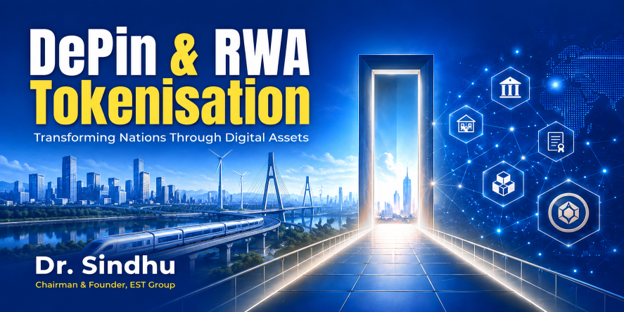

The book examines digital infrastructure, financial inclusion and emerging models of economic participation, with a sequel planned for January 2027.
CAMBRIDGE, MA, UNITED STATES, October 27, 2026 /EINPresswire.com/ — Dr. Sindhu Bhaskar, Chairman and Founder of EST Group and a Forbes Council Member, has released his new book, DePIN & RWA Tokenisation: Transforming Nations Through Digital Assets. Released globally on Amazon on September 30, 2026, the publication examines how decentralized physical infrastructure networks (DePIN) and real-world asset (RWA) tokenisation could influence digital economies, financial systems and socio-economic development.
The book explores the relationship between physical infrastructure and digital technologies, considering how assets such as agricultural resources, energy systems, warehouses, urban facilities and community infrastructure could participate in emerging digital economic models. Its approach combines discussions of blockchain-related technologies with broader questions concerning economic participation, financial inclusion and community development.
DePIN refers to decentralized physical infrastructure networks, which use digital technologies and distributed participation to support physical infrastructure systems. Real-world asset tokenisation involves representing rights or interests in physical or traditional financial assets through digital tokens.
The book examines the potential applications of these approaches across rural and urban infrastructure, farmer finance, carbon credits, embedded banking, semantic banking, community collateral pools and decentralized governance.
Rather than focusing exclusively on technical implementation, the publication considers how these technologies might intersect with existing economic structures and the communities that depend on them. It also raises questions about transparency, access to productive assets and the role of citizens in emerging digital financial systems.
A central concept in the book is the Value Holder, which describes an individual who participates in economic activity as more than a consumer or borrower.
Within the framework presented by Dr. Sindhu, citizens could potentially contribute to, participate in and benefit from productive economic assets. The concept forms part of the book’s wider examination of how digital infrastructure and tokenised assets might reshape relationships between individuals, communities and economic resources.
The publication also introduces the concepts of Contributory Capitalism and Egalitarian Capitalism. These frameworks explore the potential for technology to support broader participation in value creation while considering human agency, community involvement and social objectives.
The book presents these ideas as a basis for discussion among policymakers, financial institutions, technologists, researchers and development professionals examining the future of digital economies.
Dr. Sindhu’s professional work focuses on digital banking, financial inclusion, emerging technologies and socio-economic development. These areas inform the book’s multidisciplinary approach to digital assets and infrastructure.
The publication considers potential connections between decentralised technologies and practical economic challenges, including agricultural finance, community infrastructure and access to financial services. It examines these subjects within a broader discussion of how digital systems could support economic participation, while recognising that implementation depends on regulatory, technological and institutional considerations.
The book features a foreword by Prof. Dr. Ingrid Vasiliu-Feltes, adding another perspective to its discussion of technology, finance and social transformation.
According to the book’s promotional materials, royalties from the publication will support homeless children. The initiative, described as “Royalty With a Purpose,” connects the publication’s stated humanitarian objective with its broader focus on economic participation.
Following the book’s September release, Dr. Sindhu has announced a sequel titled TOKENISATION: CONTOURS AND REALITIES, scheduled for release in January 2027.
The forthcoming volume is expected to explore practical considerations, implementation frameworks and execution strategies for digital asset ecosystems, building on the themes of DePIN, real-world asset tokenisation, financial inclusion and socio-economic transformation introduced in the first book.
Together, the two publications address questions surrounding the relationship between physical assets, digital financial infrastructure and evolving models of economic participation.
DePIN & RWA Tokenisation: Transforming Nations Through Digital Assets is available through Amazon India and the publisher’s website.
Book: DePIN & RWA Tokenisation: Transforming Nations Through Digital Assets
Amazon India: https://amazon.in/dp/9349299380
Publishers: https://zebralearn.com/oranges/depin-rwa-tokenisation-6a551ce927f2fa5e05e1f5ac/
Dr. Sindhu Bhaskar
EST Global Inc.
Legal Disclaimer:
EIN Presswire provides this news content “as is” without warranty of any kind. We do not accept any responsibility or liability
for the accuracy, content, images, videos, licenses, completeness, legality, or reliability of the information contained in this
article. If you have any complaints or copyright issues related to this article, kindly contact the author above.

Media gallery